Nats XC
My one month XC season reached an end yesterday at the National Cross-Country championships in Kingston, ON. I ended up 5th in a competitive field and was happy with the result.
It’s been a lot of fun training for this race over the past month. Before it was announced that Ottawa Marathon was putting up $2000 for each of the Senior team titles we (Speed River) were planning on sending a team. Once the money was on the line we started to pay a little more attention to what it would take to win the team title.
I’ve been using these XC workouts to help my ‘speed’ whereas most of my teammates have been using the same sessions as their ‘base’ training. XC training seems to compliment both marathon and 800-5000m training from opposite ends.
It was a short build-up coming off Berlin Marathon September 27th, but it went well and I got in just enough sessions where I thought I could take a run at the individual title.
I haven’t raced national xc since 2010 but I’ve raced a handful of XC races in Europe and Kenya. The races in Europe have all been similar; Africans have taken the pace out hard. I’m usually not even in the top 10 after 2km and I claw my way through the field usually finishing 4th or 5th.
Yesterday I was slow off the line but by 600m I was right up there with the leaders. Throughout the race I pushed the pace a little here and there but I never really made a consistent fast pace. There was a big pack for most of the race until it stretched out in the final 2km. With about 1km to go Chuck P-T threw in a good surge.


Anyways, when Chuck took off with about 1km to go Ross, Lucas, Alex and Winter all responded faster than me. I started to ramp it up and went by Alex and Winter with 800 to go. Alex flew back by me and went all the way up to second, behind Ross. I lost ground to the top 4 and just made sure I wasn’t going to get caught by a pack of 4 guys right on my heels.
According to my GPS I ran my last km in 2:52. Basically, Ross ran a 2:42 and the other 3 guys in front of me were under 2:50. The guys just had too much ‘pop’ in their legs at the end of the race for me to compete with. My only chance was to push the pace to the point where they would have been more fatigued by 9km.
So, why didn’t I push the pace? Well, I wasn’t confident enough to lead it out (even though the calm conditions were conducive to front running). A couple times I pushed the pace for a few seconds and contemplated keeping it going but I never went through with it. Either way it made for a really fun race and good for the spectators too.
Ross, Alex, Chuck, Lucas, and me approaching the finish line.

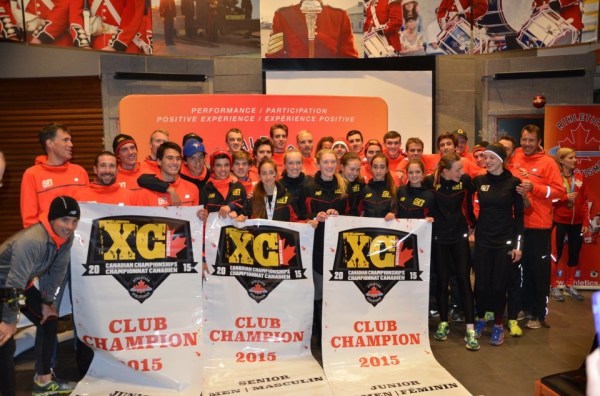
Speed River ended up winning the senior men’s title, as well as both of the junior titles. It may have looked as though we easily won but Alex and Chris (who had the same singlets as Ross, myself, Taylor, Winslow and, Jeremy) didn’t count for our squad. They are registered with Quebec and BC so can’t count for Speed River (weird rules, don’t ask).
Full squad with the 3 banners.
At the after party someone mentioned this was the strongest field up-front for at least 20 years (20 years was an odd number to say). It was a really strong field yesterday (hence why I’m happy with 5th) but it hasn’t been that long since we’ve had comparable fields.
2004 Top 6 with their SB’s:
Simon Bairu 28:28:69 10,000m (2004 NCAA XC champion)
Paul Morrison 13:26.57 5000m
Reid Coolsaet 13:31:01 5000m
Kevin Sullivan 3:34:43 1500m
Ryan Hayden 3:39:78 1500m
Dylan Wykes 7:58:70 3000m
2015 Top 5 with their SB’s:
Ross Proudfoot 13:29:32 5000m
Alex Genest 8:24:84 3000mS/C
Charles Philibert-Thiboutot 3:34:23 1500m
Lucas Bruchet 13:29:79 5000m
Reid Coolsaet 2:10:28 Marathon
You can see that Ross and Lucas at 13:29 are similar to 2004 Paul and myself at 13:26 and 13:31. Chuck and 2004 Sully are eerily close at 3:34 over 1500m. Alex Genest lines up well with 2004 Hayden/Wykes, 8:24 3000m s/c and 3:39 1500m/7:58 3000m. Bairu was a XC specialist at the time (2 NCAA XC wins in a row), he ran 28:04 on the track 6 months later.
What is crazy with today’s depth is that there were notable absentees; Cam Levins, Mo Ahmed, Justyn Knight and Matt Hughes. From memory there weren’t many big names missing in 2004.
What’s also interesting is if you compare what college system the top 10 runners attended in 2004 and 2015:
2004:
Simon Bairu NCAA
Paul Morrison NCAA
Reid Coolsaet CIS
Kevin Sullivan NCAA
Ryan Hayden NCAA
Dylan Wykes NCAA
Nigel Wray NCAA
Marcel Hewamudalige NCAA
Brent Corbitt NCAA
Jeremy Deere CIS
2015:
Ross Proudfoot CIS
Alex Genest CIS
Charles Philibert-Thiboutot CIS
Lucas Bruchet NAIA (Canadian school)
Reid Coolsaet CIS
Kevin Tree CIS
Ryan Cassidy CIS
Chris Winter NCAA
Nick Falk CIS
Evan Essalink NCAA
2004 had 1 CIS athlete in the top 9
2015 had 1 NCAA athlete in the top 9
These are just one off examples so you can’t really make any conclusions but I bet there is a trend of better runners staying in Canada over the past 10 years.
We had 7 Speed River athletes in the top 24, 5 of whom counted for Speed River
| 1 | Ross Proudfoot | SPEED RIVER TRACK & FIELD | 30:06.9 | |||
| 2 | Alex Genest | Zénix de la Mauricie | 30:09.8 | |||
| 3 | Charles Philibert-Thiboutot | C. A. Université Laval | 30:11.2 | |||
| 4 | Lucas Bruchet | POINT GREY TRACK & FIELD | 30:12.7 | |||
| 5 | Reid Coolsaet | SPEED RIVER TRACK & FIELD | 30:16.9 | |||
| 6 | Kevin Tree | NEWMARKET HUSKIES TRACK C | 30:17.8 | |||
| 7 | Ryan Cassidy | O2 | 30:18.1 | |||
| 8 | Chris Winter | UNATTACHED BRITISH COLUMB | 30:18.2 | |||
| 9 | Nicholas Falk | University of Windsor Ath | 30:18.9 | |||
| 10 | Evan Esselink | DURHAM DRAGONS ATHLETICS | 30:26.5 | |||
| 11 | Emmanuel Boisvert | C. A. Université Laval | 30:27.5 | |||
| 12 | Yves Sikubwabo | C. A. Université Laval | 30:41.6 | |||
| 13 | Taylor Milne | SPEED RIVER TRACK & FIELD | 30:43.8 | |||
| 14 | Stéphan St-Martin | Coureur Nordique | 30:51.3 | |||
| 15 | Sami Jibril | NEWMARKET HUSKIES TRACK C | 30:53.0 | |||
| 16 | Jeffrey Archer | PHYSI-KULT KINGSTON | 30:53.4 | |||
| 17 | Pier-Olivier Laflamme | Coureur Nordique | 30:54.4 | |||
| 18 | Mike Tate | UNATTACHED NOVA SCOTIA | 30:56.7 | |||
| 19 | Keenan Viney | UNATTACHED ALBERTA | 30:58.5 | |||
| 20 | Blair Morgan | PHYSI-KULT KINGSTON | 31:00.4 | |||
| 21 | Joel Deschiffart | NANAIMO & DISTRICT TRACK | 31:03.4 | |||
| 22 | Shoayb Bascal | VICTORIA INTERNATIONAL RU | 31:09.6 | |||
| 23 | Robert Winslow | SPEED RIVER TRACK & FIELD | 31:11.1 | |||
| 24 | Jeremy Rae | SPEED RIVER TRACK & FIELD | 31:15.8 |
IAAF’s sponsorship regulations from the medieval age
When I was a kid restaurants had smoking sections where people could puff away on their cigarettes indoors. The non-smoking section was typically separated by an imaginary line which meant everyone smelled like an ashtray at the end of their meal. In my opinion it was inevitable that they would eventually ban smoking completely in restaurants. It was the same with same-sex marriage. We knew that the correct policy would be put into place where everyone would have the same right to marry. The crazy thing is that there were people lobbying against moving forward.
In athletics there are advertising rules that need to be adhered to at certain levels of competition. I’m specifically referring to the regulations on logo size and the number of logos athletes can have on competition gear at IAAF sanctioned events. In my mind it’s inevitable that the IAAF will someday enter the 21st century and do away with such regulations. Or, at the very least, amend them to reflect the current state of marketing in sport.
The regulations document can be found HERE and are really specific, take section 3.1.8 for example:
Flower and Award Ribbons
If awards or flowers are given to Athletes, the name/Logo of the Supplier of the flowers or the name/Logo of up to 2 Sponsors may be displayed on both sides of the two ribbons which may be attached to such flowers. The maximum height of each individual such display shall be 5cm.
I’m not actually concerned with the flowers. My main sticking point with all the regulations is that athletes can only have one company logo on their singlet, with a maximum size of 30cm2. As well as one club logo on the front, with a slightly bigger size restriction of 40cm2.
Limiting the size and amount of logos on our competition gear limits the amount of advertising we can promote and hence the amount of sponsorship dollars we can earn. It’s hard to make a living in athletics and the rules set out by the IAAF make it even harder to make a buck.
Other endurance sports such as cycling and triathlon see athletes promoting many brands at their biggest competitions outside of the Olympics.


An energy drink company approached me earlier this year and was interested in sponsoring me. Their agenda was to get exposure at the Berlin marathon by having their logo on my singlet. I told them there were logo restrictions at IAAF races and they said they would have their team do the research. I’m sure they read the IAAF document because they never got back to me.
Last week I was helping out the Scotiabank Toronto Waterfront Marathon (STWM) race organization with the elite athletes. One of my jobs was to check the singlets, shorts, arm warmers, gloves and socks that the athletes would wear during the race. If a logo was too big we would put a piece of tape over the logo. Tape would also be placed over second (or third) logos. Sometimes that meant placing tape over local club logos which were too big. I felt bad doing this but at that stage we just didn’t want any trouble for the athlete or the race’s standing with the IAAF.
Truth be told I forgot to look out for temporary tattoos Sunday morning on the STWM start line.
New Balance gives me two singlets to wear each year. One that reads “new balance” in big letters across the front and one which only has a small logo. For most of my races I wear the one that reads “new balance” but for the big marathons I know to wear the other singlet so I don’t need to put tape on my singlet. It’s crazy to me that we cannot promote companies to the fullest. These are the companies which support athletes so they are able to train and compete at a higher level.
It’s hard to understand how putting tape over “Speed River” or having a smaller “NB” logo helps the integrity of the sport, or whatever it is the IAAF thinks they are doing with these regulations. These rules will inevitably be amended. I just wish they would hurry up with it while I still have sponsors wanting space on my gear.
Due to popular demand, here is a picture of John Mason with tape over a ‘large’ “Speed River” logo.

Berlin Marathon
A quick update here between currywurst and crepes…
Temperature was perfect, wind was nothing I should complain about (but I probably will). Course was flat. Crowds were good.
The pacers were set for 65:00 through half, roughly 3:05/km. After a few km it was apparent that our pack was pretty big, perhaps close to 20(?).
The first 5km was a bit slow (15:32), which made sense why I felt so relaxed.
From 5km to 10km I thought I might be in trouble today because it felt really fast. We ran that 5k in 15:12, which made me excited that we were now under pace and we could slow down to 15:20-15:25 and it would feel easier.
We reached halfway in 1:04:57. I felt great and was pumped that I didn’t need to run faster the second half to hit my goal.
Just after halfway some guy in our pack was complaining to the rabbits that we were running too fast. Michael Shelley told him we were perfect. He complained some more. Scott Overall said we were right on pace. He kept complaining to the pacers. Being the closest to him I yelled in his ear “WE’RE PERFECT!!” He kept quiet after that. If it’s too fast then drop back.
At 25km we were only 6 seconds off the pace and I realized that we can’t keep sliding like this or 2:09 will be lost. Slide some more we did as one of our two pacers dropped out.
Whenever the pacers went too slow a car would pull up and tell the pacers the previous km split. The car pulled up and said “3:07”. Because 23km to 29km is slightly uphill I wasn’t worried with a 3:07 knowing we could run some 3:03’s when the road went downhill.
Then a 3:08. OK, just relax.
Then a 3:11. At that point I ran shoulder to shoulder with the pacer in order to let him know to pick it up. I told the Kenyan pacer, in Swahili, to run a little faster.
Still, another 3:08.
Then I pushed the pace again and he got the point and ran a bit quicker, but maybe not for too long. We ran 25km to 30km in 15:39, 14 seconds slower than ideal and now 20 seconds behind schedule. If I kept losing 14 seconds every 5km I wouldn’t even crack 2:11 (if my post-marathon brain can do math properly).
The pacer dropped at 30km and I took over the pacing duties creating a small gap on the rest of the pack. I was ready to be aggressive, nothing to lose with the 2:11:24 under my belt from Rotterdam earlier this year.
There was a little bit of wind so when a couple guys caught back up I was OK to tuck in. It didn’t last long though as I felt the pace lag so I took off on my own again.
From 30-35km I ran 15:18 which clawed back 7 seconds. If I did that again perhaps I could get the remaining 6-7 seconds in the last 2.2km. I had to commit and fight the doubts clouding my thoughts.
Around 35km two guys caught up to me. I saw a bright yellow singlet and assumed it was Michael Shelley (2014 Commonwealth marathon champ and 14th(?) at 2012 Olympics). However it was Koen Naert, a young Belgian friend who was running his 2nd marathon(!). We worked together and dropped the Japanese athlete. I sat behind him a bit to get some respite from the wind here and there.
At 40km (2:03:43) I realized I had lost time again running the previous 5km in 15:35. At that point my main motivation was to run a PB and run the second fastest Canadian marathon time ever. It was also cool knowing I was in 6th or 7th.
Coming into the finish I could see the clock and the time was under the Canadian record. It was an indescribable feeling that over the course of 42,200m I just needed to be 120m up the road to break the Canadian record.
I crossed the line in 6th place running 2:10:29, 20 seconds off the Canadian record and 30 seconds off my main goal.
I’m happy running a PB, it’s been 4 years since I ran 2:10:55. I was really happy with 6th place in this race, especially when I look at the guys who beat me. I’m also happy with how I closed, 6:45 for the last 2.2km.
It’s frustrating to have missed the record by .5 seconds/km. A lot of things went right for me: the build-up, staying healthy, weather, good pacing/competitors… Not many things went against me although those are the things that have been popping into my head since finishing (bad pacing 25-30km and having to lead a lot in the last 14km).
I’ll take the positives and use this as a step in the right direction heading into an Olympic year.
A few people have asked if I’ll chase a 2:09 before the Olympics and I’m 99.9% sure that I won’t. I don’t want to take too many or any big risks leading into Rio. I’m excited for the next phase which is a great place to be in a few hours after a marathon when your legs are telling you “no”.
Pos. number Name ac club Erw. Diff Time
1 Kipchoge, Eliud (KEN) M30 Kenia +00:00 02:04:00
2 Kiptanui, Eliud (KEN) MH Kenia +01:21 02:05:21
3 Lilesa, Feyisa (ETH) MH ETH +02:57 02:06:57
4 Mutai, Emmanuel (KEN) M30 Kenia +03:46 02:07:46
5 Mutai, Geoffrey (KEN) M30 Kenia +05:29 02:09:29
6 Coolseat, Reid (CAN) M35 Canada +06:28 02:10:28
7 Naert, Koen (BEL) MH Belgium +06:31 02:10:31
8 Shegumo, Yared (POL) M30 Polen +06:47 02:10:47
9 Gokaya, Koji (JPN) MH Japan +06:58 02:10:58
10 Overall, Scott (GBR) M30 GBR +07:24 02:11:24
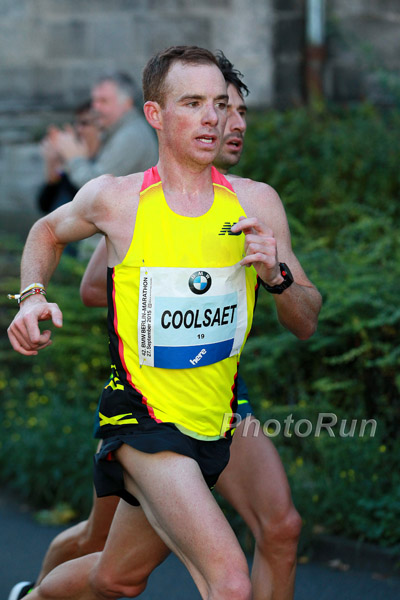
2015 Berlin Marathon
Berlin, Germany September 27, 2015
Photo: Victah Sailer@PhotoRun
Victah1111@aol.com
631-291-3409
http://www.photorun.NET

2015 Berlin Marathon
Berlin, Germany September 27, 2015
Photo: Victah Sailer@PhotoRun
Victah1111@aol.com
631-291-3409
http://www.photorun.NET

2015 Berlin Marathon
Berlin, Germany September 27, 2015
Photo: Victah Sailer@PhotoRun
Victah1111@aol.com
631-291-3409
http://www.photorun.NET
Edmonton Half
Going into Edmonton Half I backed off a few days so I could get a good feel for my fitness. I had run 5 weeks over 200km so I was due to back-off a bit anyways.
I got to Edmonton on Friday and went down to the river for a little shake-out run. At that point I hadn’t seen a start list and wasn’t sure what the competition was going to be like. On my run I saw Daniel Kipkoech, (whom I’ve met before at races), and jogged with him. To my dismay I found out he came right from Kenya. The 700m of altitude at Edmonton would feel like sea-level to him, not so for me.

Photo: Deirdre Rowland
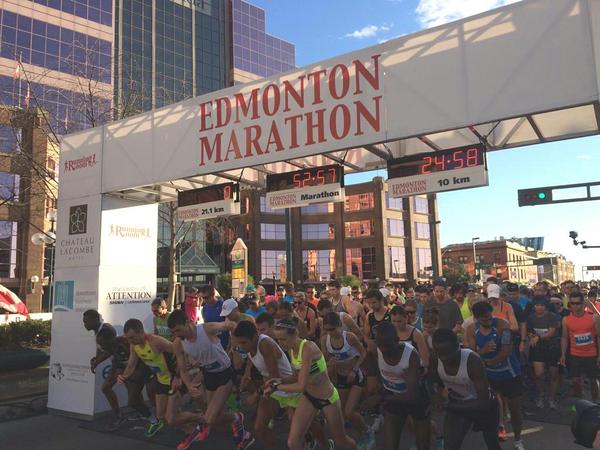
Right from the gun Daniel went out as if he was running a 10km. He went through the first km in 2:52, 12 seconds ahead of myself, Justin Young, Kip Kangogo and a few other guys. I thought Daniel was going to blow up, all I had to do was stay on my pace and bid my time. Although you should never count on an athlete to fall off pace, there was no way I was going to go out that fast anyways.
By 6km I was on my own, still about 12-15 seconds back of Daniel. For all my efforts I was not able to close the gap on him as I kept kicking off about 3:02/km. It was nice to have someone out there as a target to key off of.
Instead of closing in on Daniel in the last 5km he actually put more time into me. He won in 63:36 while I came in second in 64:09.

Photo: Trevor Hofbauer
Daniel Kipkoech 1 01:03:36.0
Reid Coolsaet 2 01:04:09.0
Kip Kangogo 3 01:05:02.0
Justin Young 4 01:05:05.0
Truth be told I would have really liked to be under 64:00. A 63:10-63:30 would have been good at sea-level so I was thinking 63:35-63:55 at Edmonton would have been about equivalent (that’s a rough guess). Basically I was 1 sec/km off so I’m not worried and happy enough with that effort. The course was flat and the weather was nice, so no excuses there.
My endurance felt fine and my leg speed lacking. That’s a good place to be 5 weeks out from Berlin. Enough time to work on ‘speed’ while maintaining endurance. I also think I’m going to race a 10km before Berlin to sharpen up.
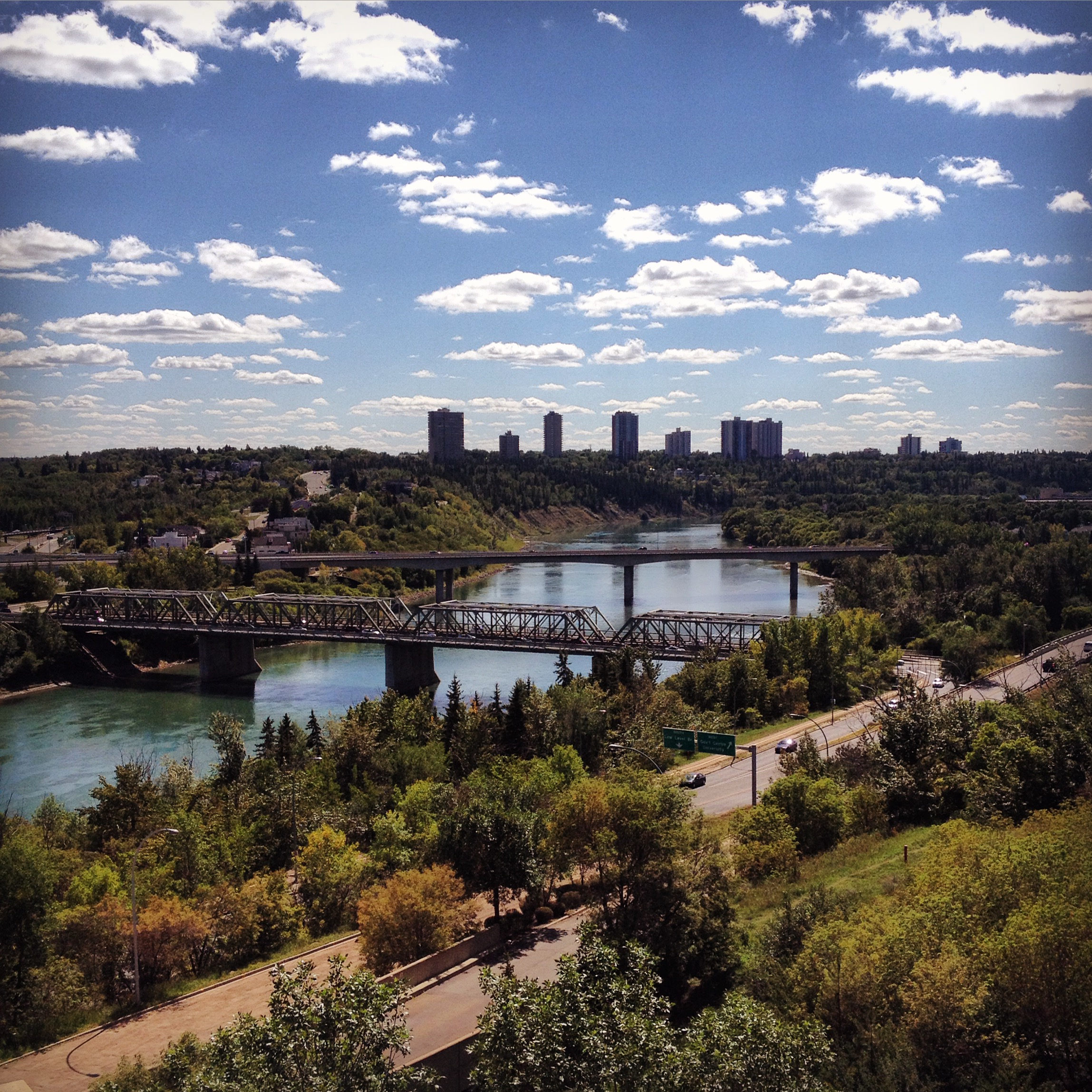
Saskatchewan River.
Step up #AlwaysInBeta
One thing I think about a lot: Shaving time off the marathon. Specifically, I think about training and execution on race day. Other factors such as weather, pacers, competitors and courses are on my mind, but I don’t have the same control over them as I do my training.
Two things I believe with training (they may not be true). One is that over time you need to change up the stimulus to attain significant physiological adaptations, the exact same training will become less effective. The other is that more time spent at a certain pace and your body will become more efficient at that pace. These two ideas seem contradictory but I believe there is merit in both and ways to see improvement while incorporating both theories.
“Insanity: Doing the same thing over and over again and expecting different results.” – Albert Einstein
When you look at my top four marathon times (2:10:55, 2:11:23, 2:11:24, 2:11:24) it looks as though I have a specific recipe I keep whipping up. Truth be told, my training program has been pretty consistent through each build-up. Perhaps I need to switch things around to break the trend. Does that mean running more volume, or more speed-work, or more hills, or more time at race pace? It’s near impossible to say as every athlete reacts/adapts differently. Plus, it’s not so simple as doing more of everything, that would invite injury.
My first three marathons in the 2:10-2:11 range came after sea-level training. To switch it up I tried altitude training this Spring before Rotterdam. I spent 10 of 15 weeks, including the last 5 weeks, in Iten, Kenya (2400m). I came down to sea-level within 72 hours and it still netted me a similar result.
Training in Iten also meant that I incorporated more hills into my program (I didn’t have a choice with the terrain). This build-up I’m going to include a few specific hill sessions to change things up a bit. On Monday I ran more elevation in a workout than I ever have before.
As far as race plans go, my top four marathons have had two different pacing strategies: ‘Go out hard’ and ‘shoot for an even split.’ My halfway splits in those four marathons have a larger variance than the final times (65 second variance at 21.1km and 29 second variance @ 42.2km) . I’ve also tried different race courses.
2:10:55 (1:03:58 @ 21.1km) – STWM 2011
2:11:23 (1:05:04 @ 21.1km) – STWM 2010
2:11:24 (1:04:11 @ 21.1km) – Fukuoka 2013
2:11:24 (1:05:03 @ 21.1km) – Rotterdam 2015
If it ain’t broke, don’t fix it
On the other hand, I know how to train for a decent result. Perhaps just hitting it perfect on the day, on a fast course (Berlin) with training I know works will get me a PB. It’s possible I’m already maximizing my training and adding anything more will burn me out. Or, varying away from a proven formula will not prepare me as well.
My running volume has been fairly consistent throughout my four marathons. In the past I’ve hit some weeks around 240km and could tell from the way I felt (compared to 210km or 220km per week) that I don’t need to go that high. I ran a little less before the last marathon as I was training at altitude (and travelling a bit more too). This build-up I’ve been in the same wheelhouse. One difference is that I plan to cut back a little more in the last month to be sharper for specific sessions.
I used to run 12 times per week and now I only run 10 times per week. I try to run a little more on some of the other runs but I don’t quite make up the difference. Running two less times allows me to recover better.
Mind over matter
We all know that the mind plays an important role on race day. Once the training is complete and you’re at a given fitness level the mental side is what will make or break a race. I know I perform better when running in a pack. That is why I will change up my pace (within a reasonable amount) on race day to run with a pack. Berlin will have a good pack up front with plenty of pace makers but I don’t need to go out at World Record pace.
Being motivated when things get tough is what helps me stay on pace. I have to ‘really want it’ to run through the pain. In the past I’ve put lots of pressure on myself and at other times I’ve been relatively nonchalant. There is a sweet spot in the middle where I need to operate.
I can’t be afraid of excellence. I know that might sound strange but sometimes when you want something so bad and you put that end result on a pedestal it can be overwhelming. I felt that a bit in Fukuoka. I remember coming through halfway in 64:11, feeling pretty good and thinking even if I slow down a bit I’ll still hit my goal. The goal became so achievable that I was scared. In Rotterdam I wasn’t scared to take that next step.
Every time I race I learn more about myself and it always surprises me when I figure out more to the mental side. I know it’s important, I’ve always known it’s important but there is so much more to be learned in that department.
Next Step
One of the reasons I keep thinking about all these things is that I don’t have tons more opportunities to run a personal best. I don’t want to finish my career and wonder if I could have done things differently to run faster. Had I never trained at altitude going into a marathon I know I would have questioned what I could have done with such training.
So while I try and become more efficient at marathon race pace I’m also tweaking other aspects of my training to see if I can become stronger.
My next race is the Edmonton half marathon on August 23. Surprise surprise, a half marathon 5-6 weeks before a marathon (same thing as all the 2:10-2:11 races). Although I did try a half 4 weeks out before the London marathon in 2013. I didn’t like the way I felt, ran 2:13:40 so decided not to try that again.
Pan Ams, Berlin, Doping, AC HOF
Pan Ams
Once Athletics got under way at the Pan Am games I was feeling a little left out, as I thought I probably would. I thought the Pan Ams was a great success for Toronto and Canada. I enjoyed being in Toronto and seeing all the stuff going on and had a great time at the gold medal soccer game.
When distance runners started to win medals I wanted to get out there and run the marathon. Looking over the men’s start list I would have had the fastest PB but there were two guys on the start list who beat me at the Olympics in similar hot conditions. Raul Pacheco, who I figured for the marathon win, finished second to a surprise performance by a Cuban. The times weren’t fast but given the hill they had to run four times and the heat it looked like a tough race.
As much as I would have liked to race Pan Ams I’m happy with my decision to focus on the Berlin marathon this fall. Berlin is known as the fastest course and if all goes well next year I’ll be racing Rio in August. I wouldn’t race Berlin 4-5 weeks after Rio and I’d like to race Berlin while I still feel I can PB. It’s too hard to predict how I’ll be going in 2017.
Doping Documentary
A hard-hitting documentary on doping out of Germany aired last week. (You can watch the English version here) The reason why this documentary has been the talk of the athletics community is because it presents some very compelling evidence. I thought I was about to watch a lot of heresay but there’s quite damning information presented.
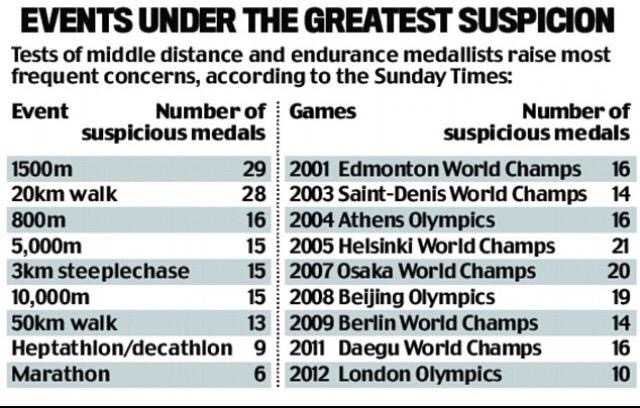

The first half of the documentary focuses on Russia and the second half on Kenya. The section on Russia didn’t faze me as they’ve had a very dirty history. The section on Kenya hit me much harder as I recognized many of the places in the film. I’ve been aware that Kenya has a doping problem but I didn’t expect to see how easily athletes there can dope. It makes me feel uncomfortable knowing how close I’ve been to a doping problem.
The ease at which athletes can dope in Kenya combined with the lack of effective testing makes the whole situation look like a dopers paradise. Athletes often get a weeks notice before they are to be tested. I think this is partially due to not having proper addresses in rural Kenya. Without street signs and house numbers I doubt athletes have to fill out their whereabouts* with the same accuracy many other athletes do.
I still believe it’s a small percentage of athletes who are doping in Kenya and that the country’s success largely comes from hard work, genetics and culture. However, since the majority of Kenyans are running for monetary gain and how competitive it is just to get a break (race abroad) it doesn’t come as a huge surprise there are cheats given the risks and rewards.
The rewards are pretty obvious for a Kenyan who grows up in poverty where prize money can completely change their life. And the risks aren’t too grim. They don’t seem to have to repay money, no risk of incarceration and they can resume racing after four years (used to be two years). On top of that the chances of getting caught in Kenya are slim to none.
In my opinion the punishment for drug cheats isn’t harsh enough, not even close. The consequences have to be such to deter more athletes who are still choosing to cheat.
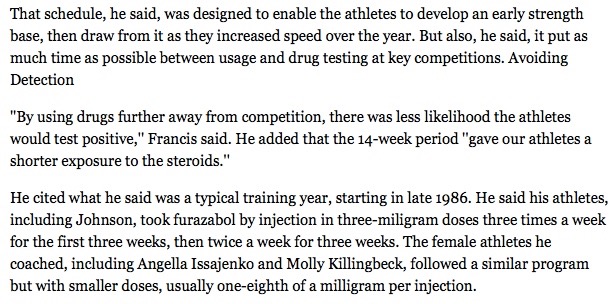
At the very least you cannot reward dopers! Athletics Canada keeps inducting drug cheats into their Hall of Fame. This is something that has bothered me for a while and since I’m on the subject I might as well rant about it.
Drug cheats Mark McCoy and Molly Killingbeck were inducted in 2014 and 2015, respectively. They were both sprinters under Charlie Francis and were both implicated in the Dubin inquiry (just like Ben Johnson). Athletics Canada is sending the wrong message by rewarding these athletes. They are basically saying that doping is an acceptable avenue to reach Hall of Fame level performances. It’s like awarding a Pulitzer Prize to someone who plagiarized a book.
*whereabouts refers to a website/app where athletes in the drug testing pool have to input where they will sleep, train, do regular activities and have a one hour slot each day where they can be sure to test you.
My CAN-ETH-KEN Games 15km
Going into the Utica Boilermaker 15km I knew it was going to be tough just to crack the top 10. In 2009 I finished 8th and was happy with that result. The field looked really deep this year but I really wanted to improve on 8th and shoot for top 5. I ended up 8th again and ran 44:34, 45 seconds faster than 6 years ago.
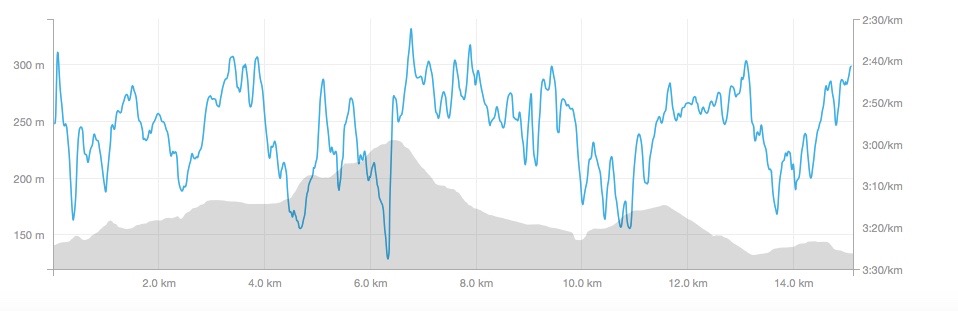
Once again it was hot on race day however this time I fully understood the nature of the hill from 4.5 to 6.5km. I knew if I wanted a shot at top 5 that I needed to be in the mix at the top of the hill. There was a pack of about 15 going into the hill and by the top the group was splintered and I was in 6th place. On the downhill I lost a few places and was 10th by the bottom.
I underestimated the guys I broke on the hill and figured I would catch them again once it flattened out. That didn’t go as planned. They were running in a pack and I was chasing alone. On a couple of occasions one guy would fall off and I would pass him. In the final kilometre I was closing-in but it was too little too late. Perhaps I got within 5-6 seconds of them but lost a little in the last bit when they kicked for the line.
The race reminded me of when I used to start a track season and be able to chop off a good chunk of time from my first outing. Being in that unfamiliar zone I found myself not knowing how hard I could actually press. It’s a good place to be in right now, although it makes me want to race another shorter race. I was tempted to race again soon but, it’s time to start increasing the volume and looking towards a Fall marathon.
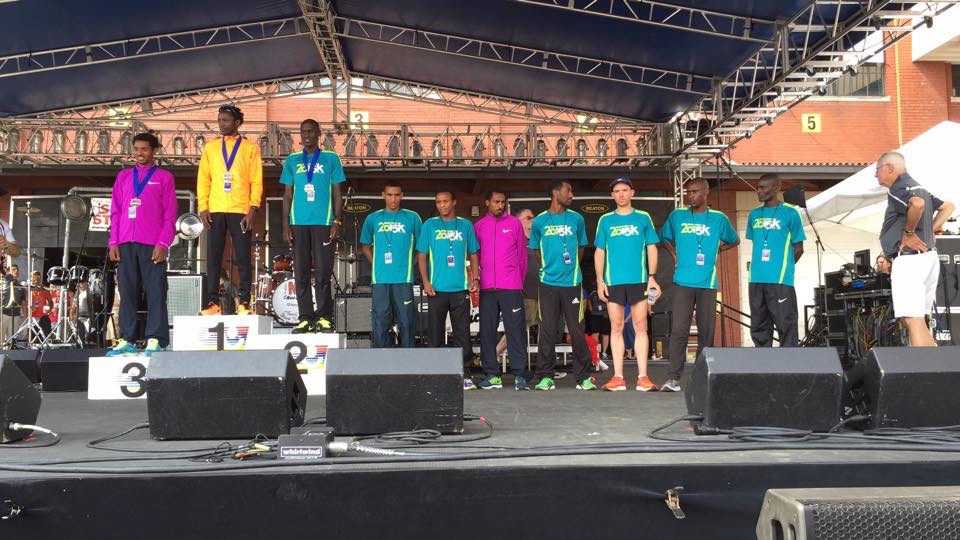
The Utica Boilermaker is a really fun race. Located in upstate NY about an hour East of Syracuse the race attracts 17,000 runners. The race finishes by Saranac Brewery and there is a massive party afterwards with over 10,000 people. They conduct the awards in between music acts on a stage in back of the brewery. The whole race sees big, enthusiastic crowds lining the roads. Check it out one year if you haven’t yet.
PLACE NAME TIME PACE RESIDENCE
————————————————————————————————————
1 Eliud Ngetich 43:31 4:41 Kenya
2 Lani Rutto 43:59 4:44 Kenya
3 Belete Assefa 44:01 4:44 Ethiopia
4 Teshome Mekoen 44:07 4:44 Ethiopia
5 Isaac Mukundi Mwangi 44:24 4:46 Kenya
6 Yitayal Atanfu 44:25 4:46 Ethiopia
7 Mengistu Tabor Nebsi 44:26 4:46 Ethiopia
8 Reid Coolsaet 44:34 4:47 Canada
9 MacDonard Ondara 44:57 4:50 Kenya
10 Linus Chumba 45:11 4:51 Kenya
11 Fernando Cabada 45:13 4:51 USA
12 Masakazu Fujiwara 45:15 4:52 Japan
13 Moses Kipkosgei 45:20 4:52 Kenya
14 Solmon Deksisa 45:50 4:55 Ethiopia
15 Gilbert Kiptog Chepkwo 46:15 4:58 Kenya
16 Ahmed Osman 46:17 4:58 USA
17 Ryosuke Fukyama 46:24 4:59 Japan
18 Tyler McCandless 46:38 5:01 USA
19 Ryan J. Place 47:03 5:03 Cambridge MA
20 Nicolo S. Filippazzo 47:13 5:04 Wantagh NY
Massive crowds!


On the way to Utica I stopped at Green Lake for a run on the sweet trails and a dip in the lake.

I’m digging the new Vazee Pace. I was worried at first because this shoe is replacing my go-to trainer, the 890. It feels close enough that it’s a an easy switch. The thing I notice the most is there is more room in the forefoot, which I don’t care for but am already used to. I know a few guys who wear out the forefoot of the 890 who will be happy to see that update.

Scotiabank Vancouver Half Marathon
My quads were sore from the Vancouver Half for four days. I know this is due to the downhill nature of the course but I don’t remember taking that long to recover from when I raced SVHM in 2012. Is age catching up to to me at 35?
I won the race again, although 2 minutes slower than 2012. That can be explained by the heat and not being pushed by Eric and Kip for most of the race. You would think running that much slower would be easier on the legs.
I’ll blame the sluggish recovery on running hilly runs after the race, drinking beer Sunday night, and not being in marathon mode (toughened legs from high km). The age factor does creep in my mind from time to time. I do a few things differently now than a few years ago. The main thing is that I run 10 times per week instead of 12. It doesn’t sound like much but those two afternoons without running really helps recovery.
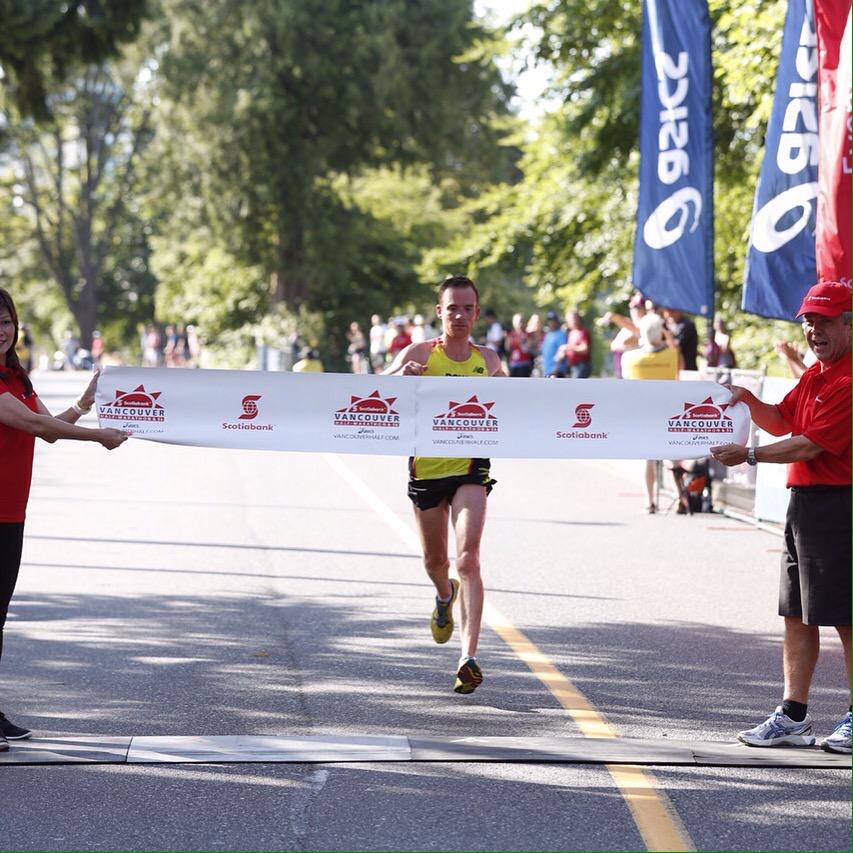
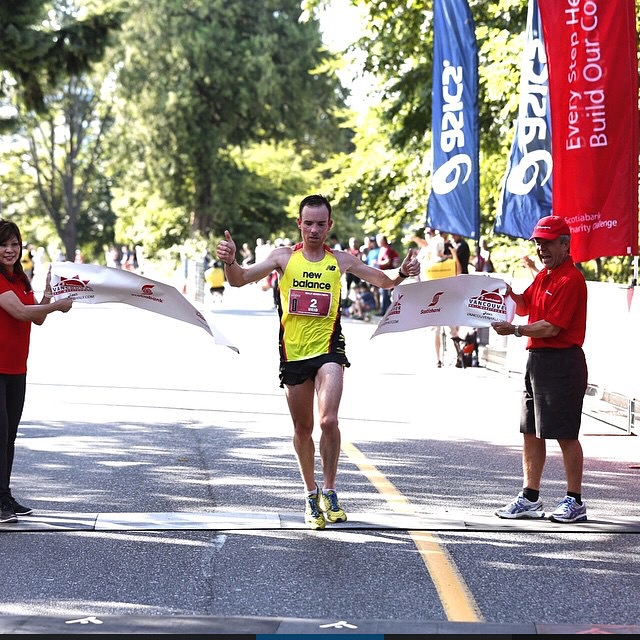
I’m excited to race the Utica Boilermaker 15km next weekend (July 12). The competition at the Boilermaker is always really tough and will give me a good fitness indicator. Even if it’s hot (slow time) I’ll be able to see where I am relative to the Africans. I raced Boilermaker back in 2009 in the lead-up to Berlin WC marathon. It’s a really fun race with over 10,000 runners in the 15km and finishes at Saranac Brewery. After Boilermaker I’ll transition into marathon training.
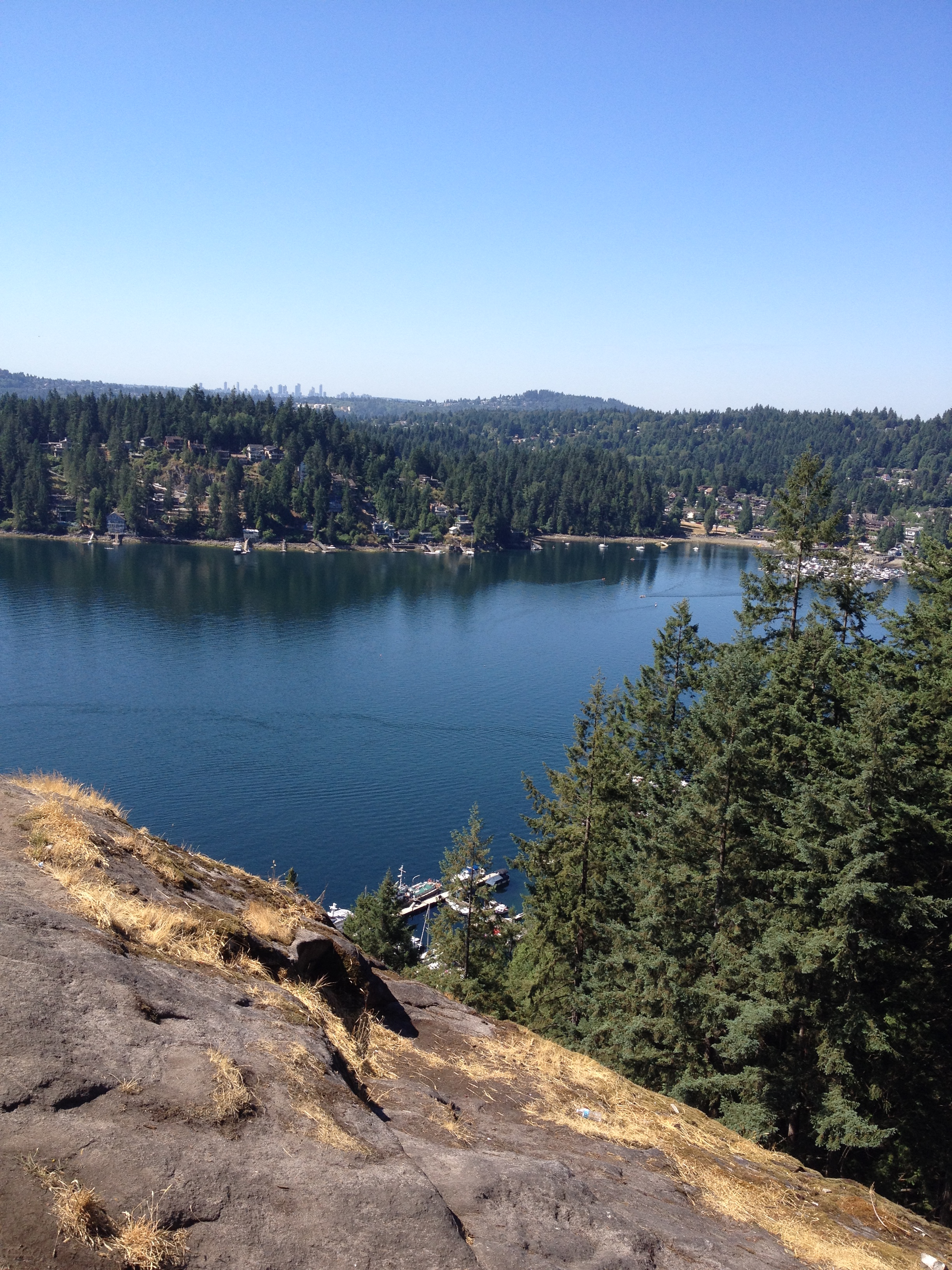
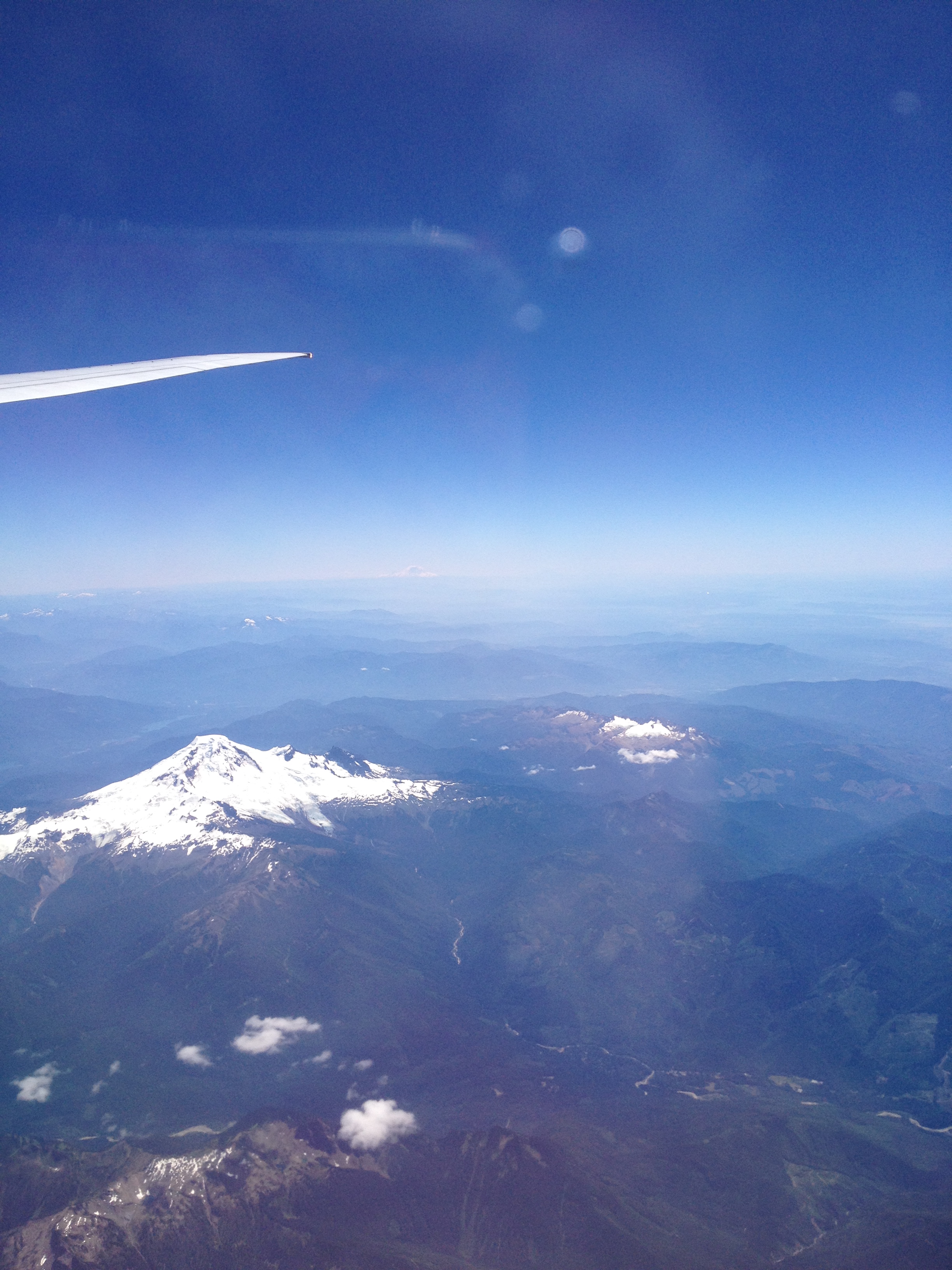
Before the race I took in the Canada vs England Women’s World Cup game. It was an amazing atmosphere and a good game but unfortunate Canada lost. After the race Marie and I spent a few days in Vancouver and went out to Deep Cove for a hike and a donut from Honey’s. Of course a stop at the New Balance Store on Robson where I got my first peak at the new Vazee running shoes (there was a pair at my house when I got home).



Calgary Half
Over the weekend I went to Calgary for the national half marathon championships looking for the win. The last Canadian championship I won (or even entered) was the 10km September 2013. I came up short in the final kick and had to settle for second place.
Heading into the race I knew I wasn’t in great shape. I have no complaints where my fitness is because it’s part of the plan to ease into training in order to peak for a fall marathon. I know I could have been more prepared for this race had I been more aggressive with my training after Rotterdam but I have to choose my battles. Even still, I thought I had a good shot at winning.
When the race started I decided it was in my best interest to keep a consistent pace. Calgary is situated at 1050m (3400 feet) which makes it a little slower than sea level. I was basically reeling off 3:05/km and four of us quickly separated from the rest. After 4km Kelly Wiebe and Trevor Hofbauer were trailing Kip and I. Kelly seemed to be way behind Trevor and then all of a sudden he was back up with Kip and I (turned out Kelly was having stomach issues and stopped three times during the race). I led through 10km in just under 31:00 and by then it was clear it was going to just be Kip and I going for the win.
I decided to let Kip lead for a couple of kilometres and we slowed to 3:11/km. That felt much easier but I was worried at that pace we would get caught. I led another 3:03/km but that was kind of tough and talked myself into trying to win in the last few km instead of pushing hard the rest of the way. The pace became really easy and almost didn’t even feel as though I was racing.
At 18km I decided to surge and drop Kip. But he was one tough bugger that day and I couldn’t shake him so I settled back down. I thought if I could get a jump on him in the final 150m I could maintain that little gap until the end.
With, what I thought was 150m to go, I surged hard. I got a little gap on him and hoped to carry it until the finish line. Then I saw the 42km mark and realized there was still 200m (195m) from that point! I was cooked. Kip passed me and I gave up the fight. A little later I saw Kip tie up but he had a big enough gap for the win.
After the race Kip told me he knew I went too early. He’s raced this course many times and was familiar with the finish.
It was good to see Kip win his first Canadian title (Kip moved to Canada from Kenya many years ago but only became Canadian last year). I was frustrated because I don’t think (even given my fitness) I played my cards right. An honest pace was probably my best bet. Oh well, live and learn.
In general I’m really satisfied with my training, fitness and health. I’ll continue with my base training for two more weeks before I notch up the intensity.
Next up is Scotia Vancouver Half Marathon on June 28th. After that I’m looking at Boilermaker in July and Crim in August.
The race video is archived at AthleticsCanada.tv HERE (at 1:15:23 into the video I have an interview with John Stanton)
| Place | Gun Time | Name | City | Chip Time |
| 1/3304 | 01:06:39 | KANGOGO, Kip | Lethbridge, AB | 01:06:39 |
| 2/3304 | 01:06:50 | COOLSAET, Reid | Guelph, ON | 01:06:44 |
| 3/3304 | 01:07:22 | HOFBAUER, Trevor | Calgary, AB | 01:07:17 |
| 4/3304 | 01:07:25 | WIEBE, Kelly | Vancouver, BC | 01:07:19 |
| 5/3304 | 01:08:41 | WINSLOW, Robert | Guelph, ON | 01:08:41 |
| 6/3304 | 01:09:08 | VIAU-DUPUIS, Philippe | Montreal, QC | 01:09:03 |
| 7/3304 | 01:09:10 | LE PORHO, David | Montreal, QC | 01:09:03 |
| 8/3304 | 01:09:14 | SNIDER, Graydon | Halifax, NS | 01:09:08 |
| 9/3304 | 01:09:22 | DEERE, Jeremy | Calgary, AB | 01:09:17 |
Yeah, we better turn up the base on this one
It’s been a month since the Rotterdam marathon. I took 11 days completely off after the race, and then spent the next 10 days doing easy runs. Last week I did a tempo and fartlek run. I’ll continue that formula for the next month as a base period.
I have to respect the recovery from the marathon and keep my eyes on the big goals. That is why I’m not ramping up too fast for the Canadian half marathon champs on May 31st in Calgary. If I want to run my best in Calgary I should be doing faster intervals right now but that would mean compromising marathon recovery. Luckily Calgary is situated at 1000m (3300 feet) above sea level which should slow the pace down and lessen the importance on speed right now.
The last two years I planned on racing a few competitive road races on the US circuit but both times the plan was foiled by injury. Once again I’m planning on racing over the summer (half, 15km, 10 miles) and focusing on speed (relatively speaking) before transitioning to marathon training.
***
I’ve officially pulled my name out of the Pan-Am games this summer, which basically means I’ve stopped filling out forms for Pan-Ams as they get emailed to me. It was a hard decision to make because I would have loved to compete for team Canada in Toronto. Also, it might be a, relatively, easy shot at an international medal.
There are a few reasons why I took my name out of selection:
1) There are a few guys who really want to run Pan-Ams and it will be good for them to have a shot at international competition. There are only two spots on the team per event in athletics.
2) The course is from Ontario Place to High Park and back (not through the middle of Toronto). There’s a good hill on the course and it could be hot, there’s really no chance of running fast. My main goal this year is to run fast because next year the goal will be Rio (championship race) if all goes well.
3) If I’m going to run marathons at this level I want to do it full-time which means I need money to make that happen. There’s no monetary incentive at Pan-Ams except for people who tell me a medal will come with sponsors knocking on my door. In my opinion there will be so many medals at Pan-Ams from Canadian athletes that by the time the marathon comes around a medal won’t be such a big deal.
***
It’s been so long since I wrote a blog I almost forgot that I haven’t mentioned Athletics Canada released the standards for the Rio Olympics. The men’s marathon standard is set at 2:12:50, which was slower than I anticipated. Had I known the standard going into Rotterdam it would not have changed the way I ran because I would have always aimed for time that I felt somewhat safe with. A time such as 2:12:20 would be vulnerable to be overtaken by 3 guys. There’s no guarantee with 2:11:24 but it’s a time which should stand up.
***
This week I’m off to Halifax to attend an event to honour Cliff Mathews on Thursday night at Spatz Theatre. Abel Kirui (2-time World marathon champ) will also be there. The money raised from the event will go towards buying a defibrillator for Iten, Kenya.
***
The marathon ages you.
Two days before marathon (Also to note, a beard makes you look older).

A few minutes after marathon.


 FLOAT ON